

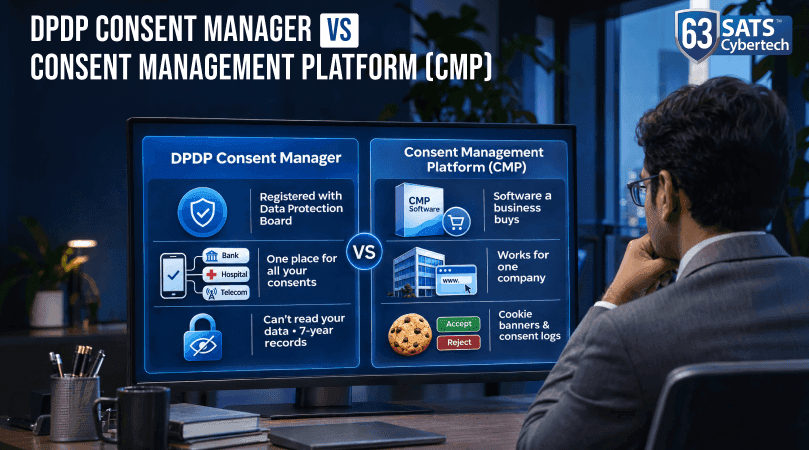
DPDP Consent Manager vs Consent Management Platform: Key Differences Explained

Summarize this blog with :
This blog explains the difference between a DPDP Consent Manager and a Consent Management Platform (CMP), two terms that are often used interchangeably but serve different purposes under India's data protection framework. It explores their legal status, responsibilities, registration requirements and practical applications, helping businesses understand how each fit into their DPDP compliance strategy.
What Is the Difference Between a DPDP Consent Manager and a Consent Management Platform?
Ask yourself this: Who does it work for?
That single question separates a DPDP Consent Manager from a Consent Management Platform more cleanly than any technical definition, table, or regulatory clause.
Consent Management Platform (CMP)
It works for the business. It's a software solution that helps a business manage consent within its own operations. It supports activities such as capturing user preferences, maintaining consent records, managing withdrawal requests and tracking consent across digital channels.
DPDP Consent Manager
It works for the individual. It's an independent, government-registered entity accountable to the user, not to you, that acts on behalf of individuals. Registered with the Data Protection Board of India (DPBI), it provides a common platform through which individuals can give, manage, review and withdraw consent across participating businesses.
Both deal with consent. But their responsibilities, accountability and roles in the data protection ecosystem are different.
Understanding this distinction is important for businesses preparing for the Digital Personal Data Protection (DPDP) Act, 2023.
What Is a Consent Manager Under the DPDP Act and How Does It Differ from a CMP?
The DPDP Act, 2023 gives Consent Manager a specific legal meaning under Section 2(g).
It defines a Consent Manager as a person registered with the Data Protection Board of India who acts as a single point of contact, enabling a Data Principal to give, manage, review and withdraw consent through an accessible, transparent and interoperable platform.
This is not simply another name for a software application.
The DPDP Rules, 2025 further establish the conditions for registration and the responsibilities of these entities under Rule 4 and the Part B of First Schedule.
To qualify for registration, an applicant must, among other requirements:
Be a company incorporated in India.
Have adequate technical, operational and financial capacity.
Maintain a minimum net worth of ₹2 crore.
Meet the prescribed governance, independence and integrity requirements.
Have its interoperable platform independently certified against the applicable data protection standards and assurance framework.
A registered Consent Manager must also act in a fiduciary capacity towards the Data Principal and avoid conflicts of interest with Data Fiduciaries.
A Consent Management Platform (CMP), in contrast, is an industry term for software that businesses use to manage consent within their own digital ecosystem. It is not a separately defined or registered entity under the DPDP Act.
A CMP does not require registration as a Consent Manager simply because it provides consent-related software.
The distinction is straightforward: a CMP is a business technology solution, while a DPDP Consent Manager is a regulated intermediary operating under a specific statutory framework.
DPDP Consent Manager vs Consent Management Platform: Key Differences
Although both support consent management, their roles differ considerably.
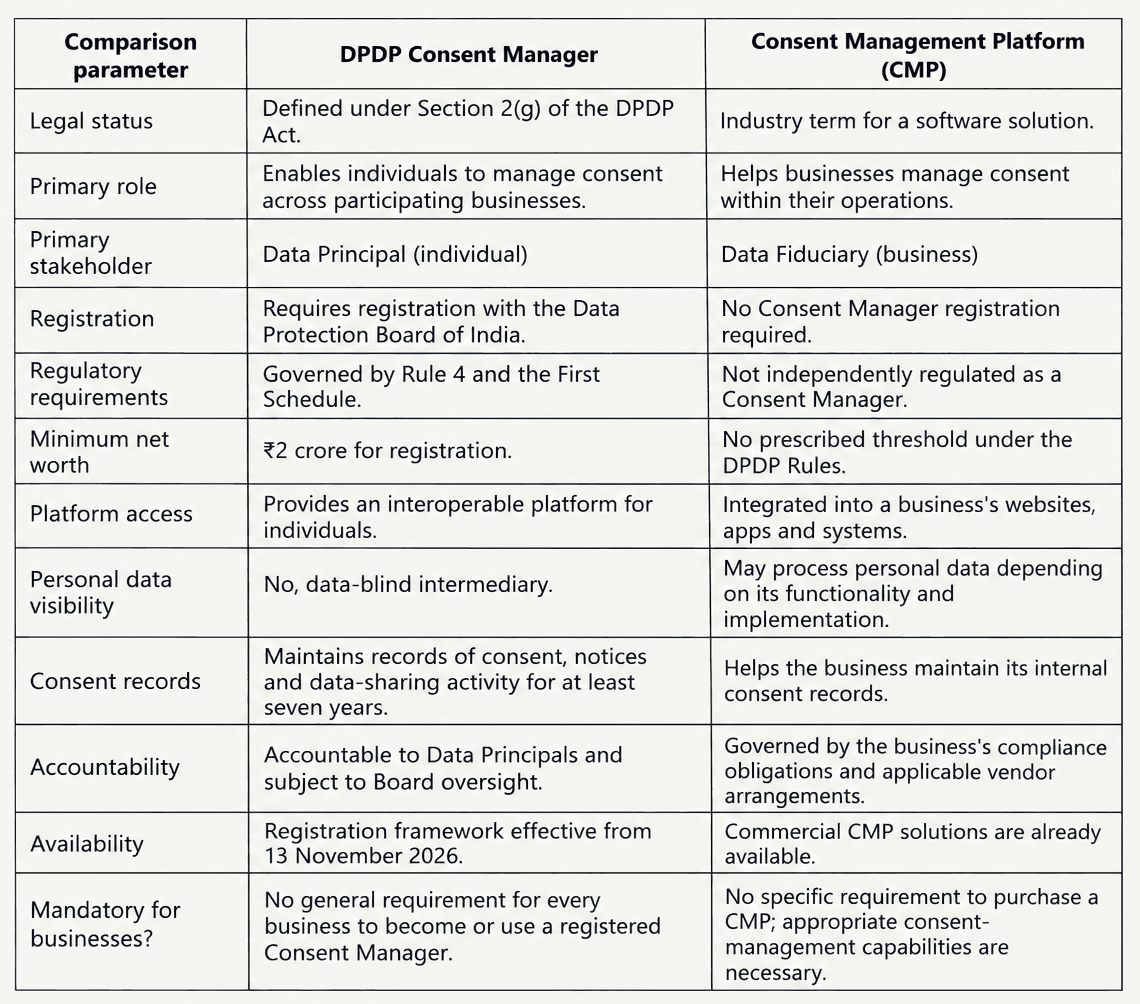
The important distinction: A business cannot rely on a CMP alone to fulfil every DPDP obligation, nor does a registered Consent Manager automatically take over the business's responsibility for managing consent.
The business remains responsible for ensuring that personal data is processed in accordance with the Act and applicable Rules.
How Do DPDP Consent Managers and Consent Management Platforms Work Together?
Imagine a user named Priya. She uses three different digital services: She shops online, uses a fintech app, and has a healthcare account. Each of these businesses has its own CMP and its own internal consent layer for capturing and recording Priya's preferences.
This is where the two concepts work together.
Now imagine Priya wants to withdraw consent from all three at once, not hunt through three separate settings pages. She opens her registered Consent Manager's app, taps withdraw, and the signal goes to all three businesses simultaneously. Each business's CMP receives that signal and updates its internal records.
In this picture:
The Consent Manager is Priya's control panel, one interface for her entire data footprint.
The CMP is each business's internal engine receiving signals, enforcing preferences, maintaining records.
They don't compete. They connect. The Consent Manager is the front door; the CMP is the control room.
The Consent Manager provides an individual-facing consent management mechanism, while the CMP supports the business's internal consent operations.
One important point: this arrangement depends on the relevant businesses being onboarded onto the Consent Manager's platform and the necessary integrations being in place. It should not be assumed that every withdrawal request will automatically update every organisation's system without those arrangements.
Common Consent Management Mistakes Businesses Should Avoid
Despite their different roles, the terms Consent Manager and Consent Management Platform are frequently used interchangeably. This can create confusion when organisations evaluate technology solutions or plan their DPDP compliance strategies.
Here are four common misconceptions worth addressing:
Thinking a CMP is the same as a Consent Manager:
It isn't. A CMP vendor calling their product a "DPDP Consent Manager" is making a marketing claim, not a legal one. After 13 November 2026, you can verify registered Consent Managers against the DPBI's published list. Use it.
Thinking a registered Consent Manager replaces your need for a CMP:
It doesn't. Even if a user grants or withdraws consent through a Consent Manager, your business still needs internal infrastructure to receive that signal, record it, enforce it across your systems, and produce an audit trail.
Thinking consent management is only about collecting consent:
Consent management does not end when a user clicks an acceptance button.
Businesses must also consider how consent is recorded, linked to specific purposes, reviewed, withdrawn and reflected across relevant systems.
The ability to demonstrate what consent was obtained, when it was obtained and how subsequent changes were handled is equally important.
Waiting until May 2027 to prepare:
The DPDP framework follows a phased implementation timeline.
The Consent Manager registration framework became effective on 13 November 2026, and the online registration portal was launched on 14 November 2026.
The other key provisions concerning Data Principal rights, Data Fiduciary obligations and related compliance requirements are scheduled to come into effect on 13 May 2027.
For organisations, this is an opportunity to assess existing consent practices and address gaps before the core compliance provisions become enforceable.
Which Consent Management Solution Does Your Business Need?
The answer depends on what you are trying to achieve.
If you are a startup, SME or growing business collecting personal data:
Focus on establishing an effective consent management process. This could include a CMP or an internally developed solution that supports consent capture, purpose-based records, withdrawal workflows and audit trails.
The objective is to build the capabilities needed to meet applicable DPDP requirements, not simply to purchase a particular product.
If you are a large enterprise in BFSI, healthcare or e-commerce:
Evaluate how consent is currently captured and managed across websites, mobile applications, customer platforms and internal systems.
A CMP may help centralise these activities. You can also assess integration requirements with registered Consent Managers as the ecosystem develops.
If you are a technology company developing consent infrastructure:
You may explore becoming a registered Consent Manager if your organisation meets the eligibility and operational requirements under Rule 4 and the First Schedule of the DPDP Rules, 2025.
This includes the minimum ₹2 crore net worth requirement, incorporation in India, appropriate governance and the prescribed technical certification requirements.
If you are evaluating a vendor offering a Consent Management Platform:
Look beyond the product's features. Assess its ability to support purpose-specific consent, withdrawal management, record maintenance, integration, security and auditability.
If the vendor also claims to be a registered DPDP Consent Manager, verify its registration independently through the Data Protection Board's published information.
The Bottom Line
A DPDP Consent Manager and a Consent Management Platform may appear similar because both deal with consent. But they operate at different levels of the data protection ecosystem.
One enables individuals to manage consent across participating businesses. The other helps businesses manage and operationalise consent within their own systems.
For organisations, understanding this distinction is an important starting point for building a practical DPDP compliance strategy.
The real objective is not simply to have a consent management tool in place. It is to ensure that consent is meaningful, properly recorded, easy to withdraw and respected throughout the data processing lifecycle.
As India's data protection framework moves towards its next implementation milestone in May 2027, businesses that address these fundamentals early will be better positioned to meet their responsibilities.
At 63SATS Cybertech, we work with organisations to navigate evolving cybersecurity, data protection and regulatory requirements. Understanding the right processes, identifying gaps and building the necessary capabilities are important steps towards strengthening data protection and long-term digital trust.
FAQs
1. What is a Consent Manager under the DPDP Act?
A Consent Manager is an entity registered with the Data Protection Board of India that enables individuals to give, manage, review and withdraw consent through an accessible, transparent and interoperable platform.
2. What is a Consent Management Platform (CMP)?
A CMP is a software solution that helps organisations capture, record, manage and track user consent across their digital platforms and systems.
3. Is a Consent Management Platform mandatory under the DPDP Act?
The DPDP Act does not mandate the purchase or deployment of a specific CMP product. However, organisations must establish appropriate processes and capabilities to comply with applicable consent-related obligations.
4. Can a Consent Management Platform act as a DPDP Consent Manager?
Not automatically. An organisation must meet the prescribed eligibility conditions and obtain registration from the Data Protection Board of India to operate as a Consent Manager under the Act.
5. What is the minimum net worth required to register as a Consent Manager?
The First Schedule of the DPDP Rules, 2025 specifies a minimum net worth of ₹2 crore, along with other eligibility, operational and governance requirements.
Source
Source 1 – DPDP Act, 2023: Read the Digital Personal Data Protection Act, 2023
Source 2 – DPDP Rules, 2025: Read the official Gazette notification
Source 3 – MeitY / PIB, 14 November 2026: Consent Manager Registration Framework Comes into Effect; MeitY Secretary Launches Online Registration Portal
Source 4 – Data Protection Board of India: Visit the DPBI registration portal