

Beyond Compliance: Why Cybersecurity Audits and Risk Assessments are Critical for India’s Aviation and Maritime Sectors

Summarize this blog with :
Beyond Compliance: Why Cybersecurity Audits and Risk Assessments are Critical for India’s Aviation and Maritime Sectors
India’s transport corridors are scaling up at a breathless pace. Deep-water terminals under the Sagarmala initiative are processing record-breaking cargo volumes, while regional airports under the UDAN scheme are bringing millions of new passengers into our domestic airspace.
This infrastructure boom relies entirely on connectivity. Our flight decks, baggage loops, cargo cranes, and automated container yards depend on complex, real-time data networks. However, this hyper-connectivity introduces a hidden vulnerability. In modern transport infrastructure, operational efficiency is only as strong as its cybersecurity posture.
As cyber threats mature globally, a passive, checklist-driven approach to security is no longer viable. Regular cybersecurity audits and proactive risk assessments have shifted from simple regulatory compliance checkboxes to foundational requirements for cyber resilience and operational continuity.
The Invisible Cyber Threat: Why Transport Needs a Diagnostic Approach
Neither an aeroplane nor a container ship functions in isolation. They rely heavily on the convergence of Information Technology (IT) and Operational Technology (OT). While a cybersecurity breach might freeze an airline’s ticketing app or a port’s billing software, an OT compromise targets physical infrastructure, disrupting radar arrays, overriding gantry crane positioning, or manipulating satellite navigation feeds.
A critical vector threatening Indian infrastructure is GNSS/GPS spoofing and jamming. Over the past few years, commercial aircraft transiting border sectors have experienced sharp increases in false GPS signal injections, which can confuse autopilot systems and trigger erratic flight-deck warnings. Similarly, the Indian Navy’s Mercantile Marine Domain Awareness Centre (MMDAC) has continuously tracked pervasive GPS jamming across critical trade routes, presenting an ongoing challenge to regional situational awareness.
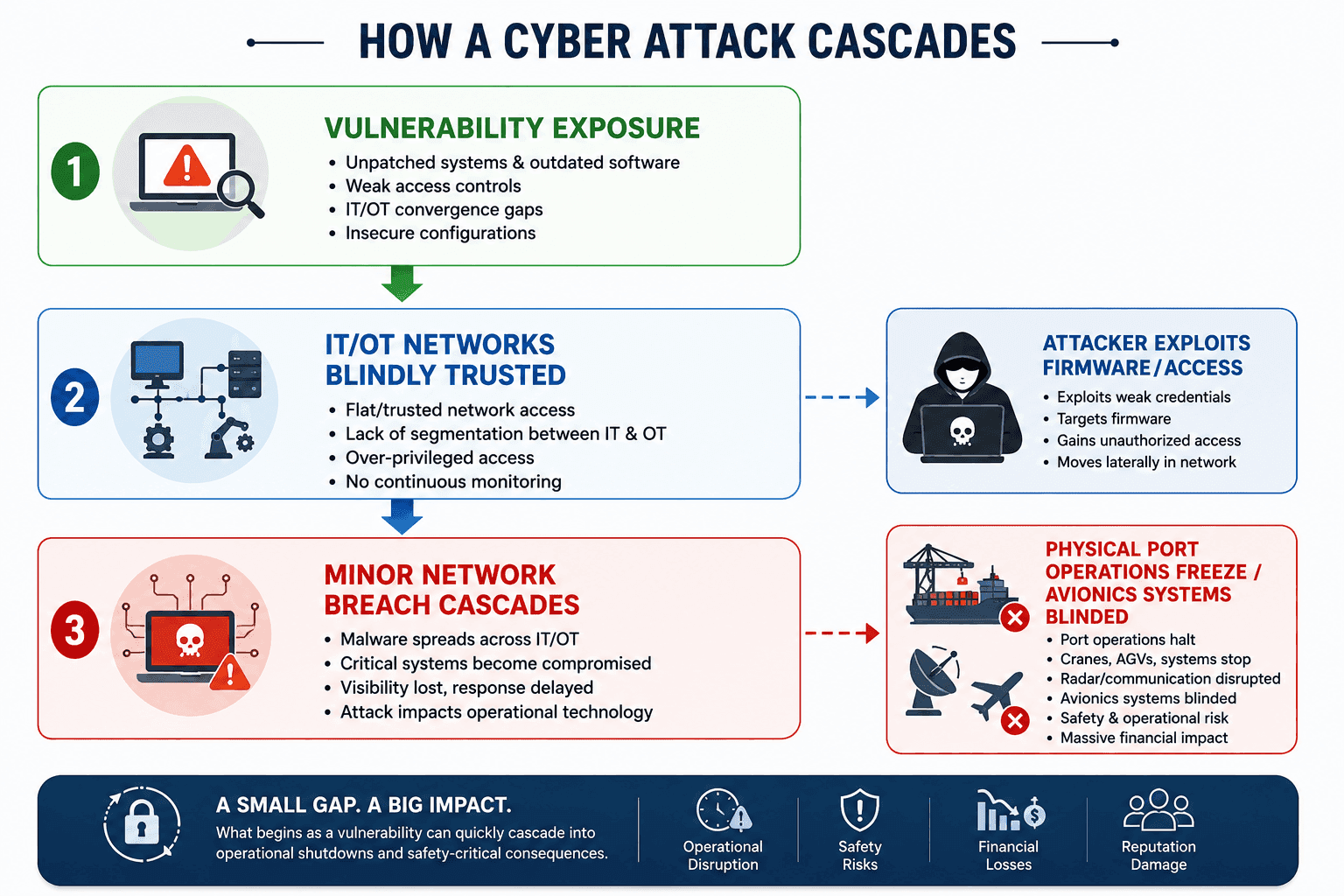
Without frequent, intensive audits, these highly specialized cybersecurity vulnerabilities remain completely invisible until an attacker actively exploits them.
1. Cyber Risk Assessments: Identifying Security Gaps Before Attackers Do
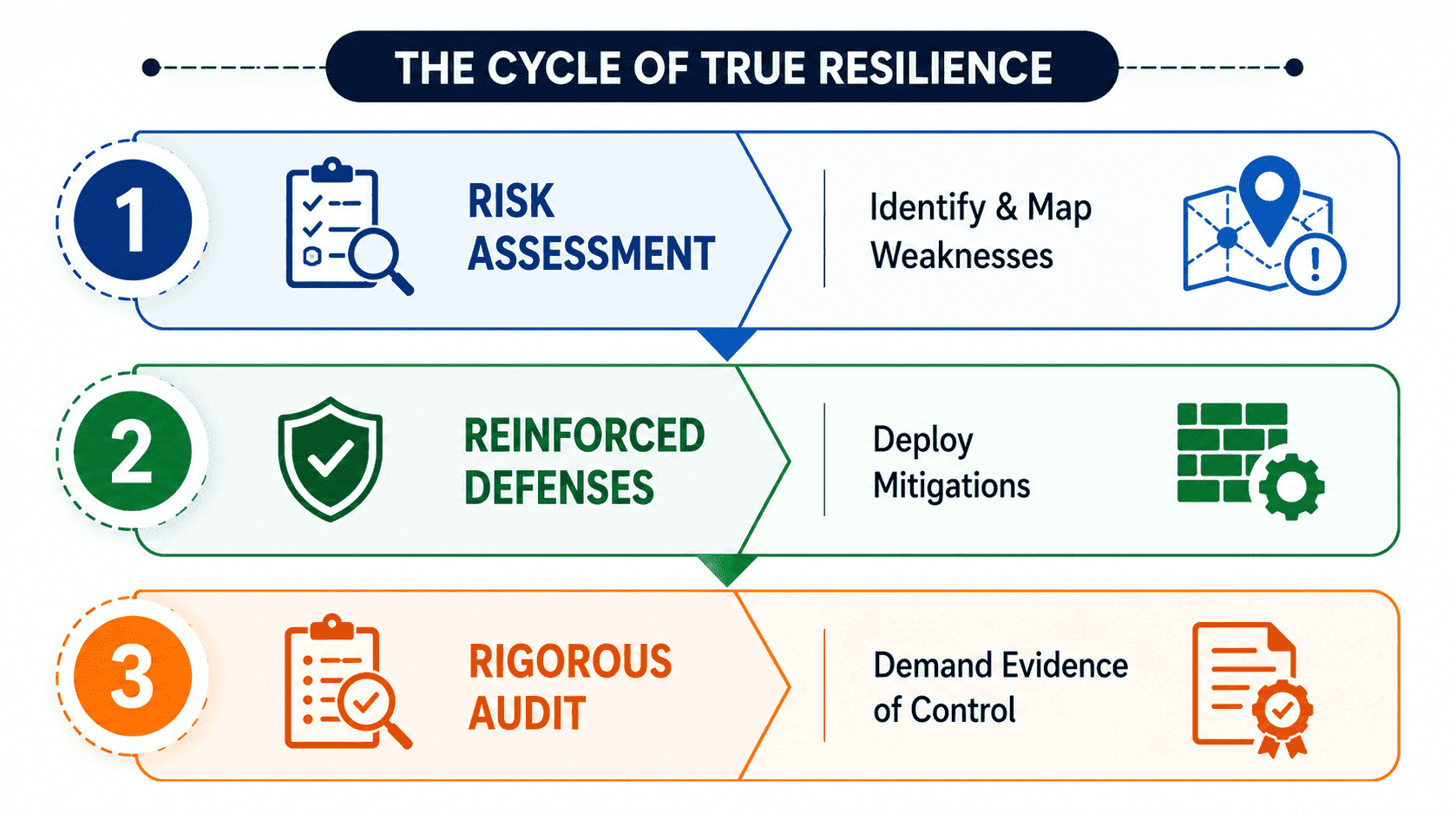
A thorough risk assessment acts as a structural stress test for an entire operational ecosystem. Rather than waiting for a system failure, it proactively asks: “Where are our highest-value assets, what are the entry points, and what happens if a core signal drops?”
In Aviation
A comprehensive Cyber risk assessment maps out the complex, interwoven data supply chain. Modern aircraft act as flying data centres, exchanging immense amounts of information with ground systems. Assessments systematically test:
The Software Supply Chain: Evaluating third-party maintenance laptops plugged into an aircraft's avionics bays during routine turnarounds.
Ground Infrastructure Failures: Simulating a sudden loss of network time synchronization at an Air Traffic Control (ATC) hub to verify backup atomic holdover clocks kick in seamlessly.
In Maritime
With ports moving rapidly toward remote automation, a risk assessment systematically reviews the entire industrial footprint:
OT Network Isolation: Verifying whether automated guided vehicles (AGVs) and quay cranes are isolated on independent, micro-segmented network layers, or if they share access with terminal office networks.
Dynamic Spoofing Mitigation: Testing how terminal container tracking software behaves when fed conflicting, manipulated location inputs.
2. Cybersecurity Audits: Moving from Theory to Evidence
If a risk assessment defines the defensive strategy, a cybersecurity audit provides the hard verification. Audits demand real, unalterable proof that security controls are properly configured, active, and functioning exactly as intended.
3. Cybersecurity Compliance for India's Aviation and Maritime Sectors
India's regulatory expectations are adapting rapidly to address these operational realities. Regulatory bodies are pushing critical infrastructure operators well past basic compliance toward documented resilience:
Skies: The Directorate General of Civil Aviation (DGCA) enforces strict reporting and operational frameworks aligned with international ICAO safety standards. Aviation audits verify that operators maintain rigorous flight safety manuals alongside active, practical incident response programs.
·Seas: Under the guidance of the Ministry of Ports, Shipping and Waterways (MoPSW), the newly established Bureau of Ports Security (BoPS) is reshaping maritime security. Grounded in the updated Merchant Shipping Rules, BoPS audits require comprehensive proof of network security across port facilities, pushing operators to benchmark their IT/OT boundaries against global frameworks like the NIST Cybersecurity Framework (CSF) 2.0.
Business Benefits of Continuous Cybersecurity Audits
Commitment to an ongoing, rigorous audit schedule yields critical operational advantages that extend far beyond simply satisfying a regulatory inspector.
1. Hardening the Third-Party Ecosystem
Airports and ports rely on extensive networks of external vendors, catering companies, logistics providers, and independent contractors. A minor breach at a secondary fuel provider or regional cargo handler can easily migrate into a primary terminal network. Regular audits enforce a strict Zero Trust environment, ensuring that every vendor connection is continuously authenticated, validated, and restricted to the absolute minimum required access.
2. Safeguarding Business Continuity
For a major hub like Delhi’s Indira Gandhi International Airport or the Jawaharlal Nehru Port Authority (JNPA), even an hour of operational downtime carries massive financial and reputational consequences. Regular penetration testing and live simulation audits ensure that internal technical teams can isolate a network breach instantly, keeping essential infrastructure running safely while containment protocols take place.
3. Transforming Organisational Culture
A truly secure transport sector requires shifting security from the server room to daily operations. Regular audits keep cyber risk top of mind for executive leadership, terminal operators, engineers, and flight crews alike. This transforms security from an abstract corporate policy into an active, practical operational reflex.
Conclusion: Why Cybersecurity Audits Are Essential for India's Transport Infrastructure
As India drives toward its long-term economic goals, our national resilience depends fundamentally on the digital safety of our trade routes and travel corridors. Security patches and hardware configurations erode over time, and threat actors constantly adapt their tactics.
By treating cybersecurity audits and deep risk assessments as essential, non-negotiable operational requirements, India’s aviation and maritime industries can confidently build an infrastructure that is not only expansive and efficient but built to withstand modern digital threats.