

KYC vs DPDP Consent in Banking: Key Differences and Compliance Risks in 2026

Summarize this blog with :
This blog explains why KYC compliance does not automatically fulfil an organisation's obligations under the Digital Personal Data Protection (DPDP) Act. While KYC establishes customer identity and meets regulatory requirements, DPDP governs the lawful processing, use, retention and sharing of personal data. It examines the compliance challenges banks face around data retention, consent withdrawal, purpose limitation and third-party data sharing. It also explores how consent management platforms can help financial institutions manage customer permissions and prepare for the DPDP compliance milestones in 2026 and 2027.
Why KYC Compliance Does Not Automatically Mean DPDP Compliance?
When a customer opens a bank account, the bank collects personal information, verifies identity and obtains the necessary documents to complete the Know Your Customer (KYC) process. From an operational standpoint, the process may appear complete: identity verified, records maintained, and regulatory requirements fulfilled.
But banks must also ask another question: Does completing KYC also give the bank permission to use that customer's personal data for other purposes?
Not necessarily.
KYC and consent under the Digital Personal Data Protection (DPDP) Act, 2023, serve different purposes. KYC establishes a customer's identity, and it also helps in preventing financial crime. The DPDP Act governs how digital personal data is processed, used, stored and shared. It also covers non-digital records that are later digitised.
The distinction becomes particularly important when customer information collected during onboarding is subsequently used for marketing, analytics, profiling or sharing with third parties.
With the DPDP Rules, 2025, introducing a phased implementation timeline, banks have a limited window to review their existing data practices and address potential compliance gaps. The Consent Manager registration came into force on 13 November 2026, while the main set of operational obligations under the Rules is scheduled to come into force on 13 May 2027.
Status as of 23 November 2026:
Rule 4 and Section 6(9) are in force, and the Board’s portal (dpbi.gov.in) accepts Consent Manager applications. No Chairperson or Members of the Data Protection Board have been publicly reported as appointed, so no Consent Manager is registered yet (as of 19th Nov 2026).
From 13 May 2027: notice, consent, security safeguards, breach reporting, retention and erasure, children’s data, customer rights, Significant Data Fiduciary duties and the penalty provisions. The right to use a Consent Manager also applies from then.
Understanding where KYC obligations end and DPDP responsibilities begin is an important part of banking compliance.
KYC vs DPDP Consent: Understanding the Key Differences
The simplest way to understand the differences is as follows:
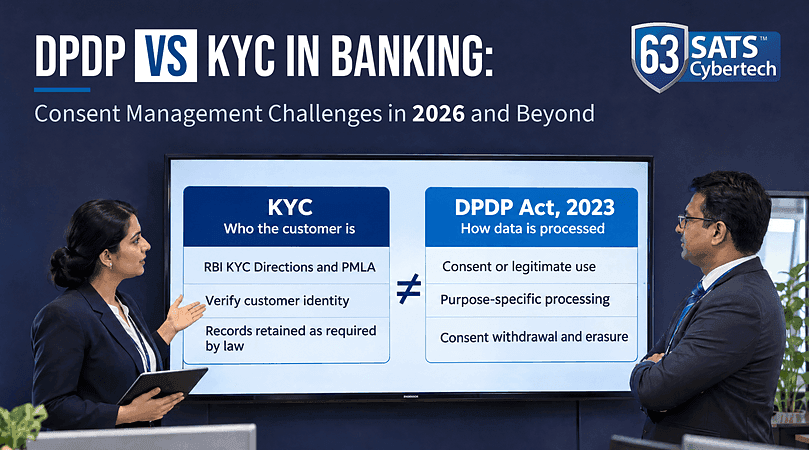
KYC establishes who the customer is. DPDP governs how their digital personal data can be processed.
KYC is a regulatory due diligence process mandated under applicable requirements, including the Reserve Bank of India's (RBI) Master Direction on KYC and the Prevention of Money-Laundering Act (PMLA). It involves verifying customer identity, understanding the nature of the customer relationship and maintaining the necessary records.
DPDP compliance addresses a broader set of responsibilities. It requires organisations to establish a lawful basis for processing personal data, provide appropriate notices, respect consent choices where consent is the basis of processing, and manage personal data throughout its lifecycle.
The DPDP Act recognises two grounds for processing personal data: consent and certain legitimate uses under Section 7. Therefore, not every instance of data processing needs consent. However, an organisation cannot assume that information collected for KYC can automatically be used for unrelated purposes.
KYC vs DPDP Consent: A Side-by-Side Comparison
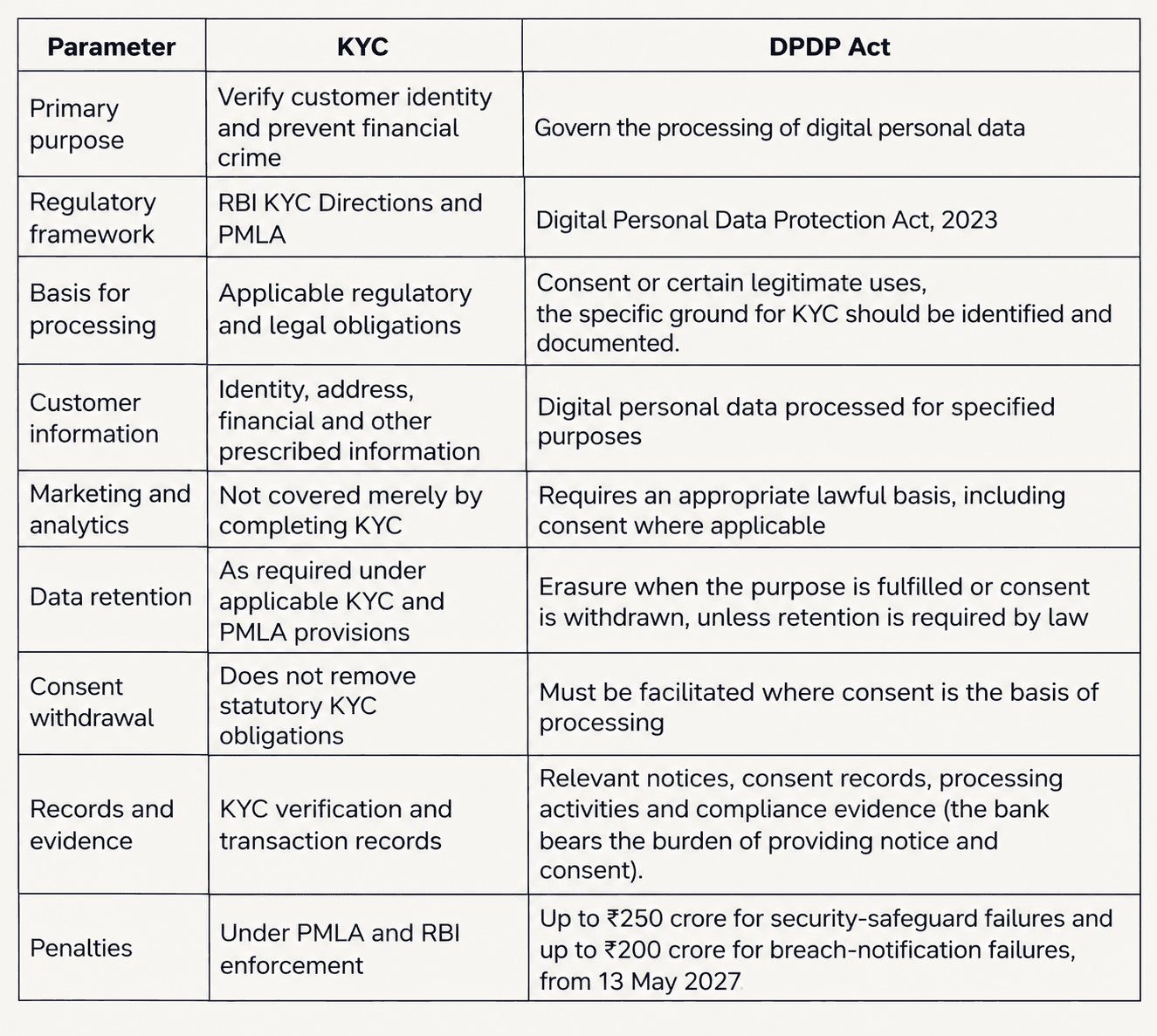
The important distinction is that the same customer information may be processed under different legal grounds for different purposes. A bank must be able to identify and document those purposes rather than treating the original KYC exercise as blanket permission for subsequent data use.
Seven Key DPDP Compliance Risks Banks Need to Address
The difference between KYC and DPDP may seem straightforward on paper. The challenges become more complicated when customer information moves across banking systems, departments and third-party platforms.
Here are seven areas that deserve particular attention.
1. Data Retention vs the Right to Erasure
Banks are required to retain certain customer identification records under applicable KYC and PMLA requirements. Under Section 12(4) of the PMLA, records relating to customer identity must generally be maintained for five years after the business relationship ends or the account is closed, whichever is later. Transaction records have a separate five-year retention requirement.
The DPDP Act also addresses data erasure. Under Section 8(7), a Data Fiduciary must erase personal data when the specified purpose is no longer being served, or consent is withdrawn, including processors engaged in processing the data, unless retaining that information is necessary to comply with another law.
This means banks do not have to delete records simply because a customer withdraws consent when another applicable law requires those records to be retained.
However, the exemption should not be treated as a blanket justification for retaining every piece of customer information.
For example, a bank may need to preserve KYC records for the statutory retention period. That does not automatically justify retaining unrelated marketing preferences or analytics data after the relevant purpose has ended.
The practical requirement is to establish clear retention policies based on the purpose and applicable legal obligations.
2. Bundled Consent During Customer Onboarding
Customer onboarding often involves several activities at once: account opening, KYC verification, product selection, communication preferences and optional service enrolments.
In some cases, marketing permissions and third-party product preferences may be presented alongside mandatory onboarding documentation. Customers may end up agreeing to several activities without clearly understanding which permissions are necessary and which are optional.
This makes it important for banks to distinguish mandatory regulatory processing from optional activities that rely on customer consent.
RBI's customer protection framework also addresses compulsory bundling of financial products and services. Banks should review the applicable Responsible Business Conduct Directions alongside DPDP consent requirements, as the two frameworks address related but distinct aspects of customer choice and protection.
The DPDP Act requires consent to be free, specific, informed, unconditional and unambiguous, supported by a clear affirmative action. Consent must also be restricted to only the personal data required for the specified purpose. The request must come with a notice (Section 5; Rule 3) that is standalone, in plain language, itemises data and purposes, explains withdrawal, rights and the complaint route to the Board, and is available in English or an Eighth Schedule language. Withdrawing consent must be as simple and convenient as providing it (Section 6(4))
These requirements reinforce the importance of clear customer choices, although compulsory product bundling and DPDP consent are distinct regulatory issues.
Banks should review onboarding journeys, consent screens and communication preferences to ensure that customers can make informed choices without unnecessary conditions being attached to essential services.
Legacy customers: for consent given before the provisions apply, Section 5(2) requires notice as soon as reasonably practicable. For banks with large existing customer bases, this is a major workstream to plan now.
3. Purpose Creep: When KYC Data Is Used Beyond Its Original Purpose
Purpose creep is one of the less visible risks in banking data management.
Consider a customer who shares personal information and identity documents to open a savings account. The bank subsequently uses information from the customer's profile for marketing campaigns, product recommendations, analytics or sharing with business partners.
Some of these activities may have a legitimate basis, while others may require separate consent. The original KYC requirement alone does not establish the legal basis for every subsequent use.
Under the DPDP framework, banks need to identify the purpose behind each processing activity and determine whether it is supported by consent or an applicable legitimate use.
This becomes particularly important when information moves between core banking systems, customer relationship management (CRM) platforms, marketing applications and external service providers. Processors need a written contract (Section 8(2)), and the bank stays responsible for them.
Without clear purpose mapping and appropriate controls, banks may struggle to demonstrate that customer data is being processed within the applicable legal boundaries.
4. Security Safeguards and Breach Reporting
Banks must keep reasonable security safeguards (Rule 6) and, after a breach, notify the Board and each affected customer, with a detailed report to the Board within 72 hours (Rule 7). Security failures sit in the highest penalty tier. Breach readiness is a sensible early priority
5. Significant Data Fiduciary Status
Large banks are plausible Section 10 notification candidates. SDFs need an India-based DPO, an independent audit and annual DPIAs (Rule 13), and may face cross-border restrictions (Rules 13(4), 15). Read these with RBI’s payment-data localisation rules.
6. Children’s Accounts
Minor accounts need verifiable parental or guardian consent (Section 9; Rules 10–12). Tracking, behavioural monitoring and targeted advertising aimed at children are prohibited.
7. Customer Rights and Grievances
Customers have rights of access, correction, erasure, grievance redressal and nomination of another person on death or incapacity (Section 14). Banks must publish contact details of a person who can answer questions.
What Is a Consent Manager Under the DPDP Act?
A Consent Manager is a registered entity that acts/provides a single point of contact for individuals to give, manage, review and withdraw consent through an accessible, transparent and interoperable platform.
Under the DPDP Act, Consent Managers are intended to give individuals greater control over their personal data and consent choices.
The DPDP Rules, 2025, introduce a registration framework for Consent Managers under Rule 4. Came into force on 13 November 2026
For banks and financial institutions, this introduces another important consideration: how consent-related activities will be managed and integrated with existing customer-facing systems.
It is equally important to distinguish an organisation's internal consent management platform from a registered Consent Manager under the DPDP Act. They are not interchangeable. An internal platform can help a bank manage its own consent records and workflows, whereas a registered Consent Manager operates under the specific statutory framework and obligations prescribed by the Act and Rules.
Why Banks Need a Consent Management Platform?
Managing customer consent across multiple branches, mobile applications, internet banking channels, call centres and third-party relationships can become difficult without a centralised approach.
A well-designed consent management platform can help banks establish consistency, maintain evidence and manage consent-related workflows across their operations.
Key capabilities to consider include:
Purpose-based consent management: Record customer permissions against clearly defined processing purposes rather than treating consent as a single blanket approval.
Consent capture and documentation: Maintain records of consent requests, notices, affirmative actions, timestamps and relevant communication channels.
Consent withdrawal management: Capture withdrawal requests and communicate the changes to relevant internal systems and data processors.
Centralised consent visibility: Provide authorised teams with a consolidated view of customer consent status and related records.
Data retention and deletion workflows: Support retention policies that distinguish between statutory records and data processed for consent-based purposes.
Audit and reporting: Maintain evidence that helps compliance teams review consent-related activities and demonstrate accountability.
Legacy-notice and parental-consent workflows, and readiness to integrate with registered Consent Managers.
These capabilities can help strengthen risk and compliance in banking while reducing the operational challenges associated with managing customer permissions at scale.
What Banks Should Do Before May 2027?
Preparing for DPDP compliance requires more than updating privacy notices or introducing a consent checkbox on digital forms. Banks need to understand how personal data moves through their organisation and whether each processing activity has an appropriate legal basis. Given possible earlier enforcement, treat May 2027 as the outer limit.
The following steps provide a practical starting point.
1. Map customer data flows
Identify what personal data is collected, where it is stored, how it is processed and which internal teams or external parties have access to it. Document the purpose and applicable legal basis for each activity.
2. Review KYC and onboarding processes
Examine existing account-opening forms, digital onboarding journeys and customer communication preferences. Ensure that mandatory KYC processing is distinguished from optional activities that require consent.
3. Establish purpose-based retention policies
Classify customer information according to its purpose and applicable retention requirements. Define how statutory records, marketing information and other consent-based data should be retained, archived or erased.
4. Strengthen consent withdrawal mechanisms
Provide accessible ways for customers to withdraw consent wherever consent is the basis of processing. Ensure that withdrawal requests are communicated to relevant systems and processors, while preserving processing that remains necessary or authorised under applicable law.
5. Review third-party data-sharing arrangements
Identify vendors, service providers and partners that process customer information. Review contractual arrangements, security safeguards, processing instructions and responsibilities for responding to customer requests and personal data breaches.
6. Assess consent management technology
Evaluate whether existing systems can support purpose-specific consent capture, record maintenance, withdrawal workflows and audit requirements. Consider how an enterprise consent management platform can integrate with banking applications and other data systems.
7. Prepare breach response
Build the Board and customer notification process, including the 72-hour report.
8. Assess SDF exposure and cross-border flows
Plan for the DPO, DPIA and audit, and review transfers alongside RBI localisation rules.
9. Plan legacy notices, children’s consent and rights handling
Assign owners and timelines for each.
Closing Perspective: Bringing KYC and DPDP Compliance Together
KYC and DPDP compliance should not be treated as competing requirements. Both are important to responsible banking, but they address different aspects of customer information management.
KYC ensures that banks meet their customer identification and financial crime prevention obligations. DPDP adds accountability for how digital personal data is processed, used, retained and shared.
The challenge is to make these requirements work together without allowing one to become a substitute for the other.
As the DPDP implementation milestones approach, banks that review their data flows, establish clear processing purposes and strengthen consent management practices will be better positioned to address regulatory expectations and maintain customer trust. With the Act and Rules now in place and compliance deadlines drawing near, banks should seek independent legal and professional advice tailored to their specific obligations.
At 63SATS Cybertech, the focus is on helping organisations strengthen their cybersecurity, data protection and compliance capabilities through practical assessments and security-led approaches. For financial institutions, bringing data governance, privacy requirements and technology controls together is an important step towards building a more resilient compliance framework.
FAQs
1. What is the difference between KYC and DPDP consent in banking?
KYC verifies a customer's identity to meet regulatory requirements, while DPDP consent governs how their digital personal data is processed and used. Completing KYC does not automatically authorise banks to use customer information for marketing, analytics or unrelated purposes.
2. Does a bank need customer consent to process personal data under the DPDP Act?
Not in every case. The DPDP Act permits personal data processing based on consent or certain legitimate uses under Section 7. Banks must identify the applicable legal basis for each processing activity and obtain consent wherever required.
3. What is a Consent Manager under the DPDP Act?
A Consent Manager is a registered entity that provides individuals with a single point of contact to give, manage, review and withdraw consent through an accessible, transparent and interoperable platform. Its registration and obligations are governed by Rule 4 of the DPDP Rules, 2025.
4. What is a consent management platform, and why do banks need one?
A consent management platform helps banks capture, record, track and manage customer consent across different channels and systems. It supports purpose-specific consent, withdrawal management, audit trails and consent-related compliance workflows under the DPDP framework.
5. What should banks do to prepare for DPDP compliance by May 2027?
Banks should map customer data flows, review KYC and onboarding processes, establish purpose-based data retention policies, strengthen consent withdrawal mechanisms, assess third-party data-sharing arrangements and implement appropriate consent management and breach-response processes.
Sources
1. DPDPA, 2023 - Read the official DPDP Act, 2023
2. DPDP Rules, 2025 - Read the official DPDP Rules, 2025
3. RBI Master Direction – KYC- Read RBI KYC Master Direction
4. Prevention of Money-Laundering Act, 2002 - Read PMLA, 2002
5. RBI Draft Guidance on Regulatory Expectations for Data Governance -Read RBI's July 2026 announcement